How "Common Knowledge" Gets Manufactured
Why do obviously false ideas become "common knowledge"? Follow the money, the repetition, and the social punishment of doubt.
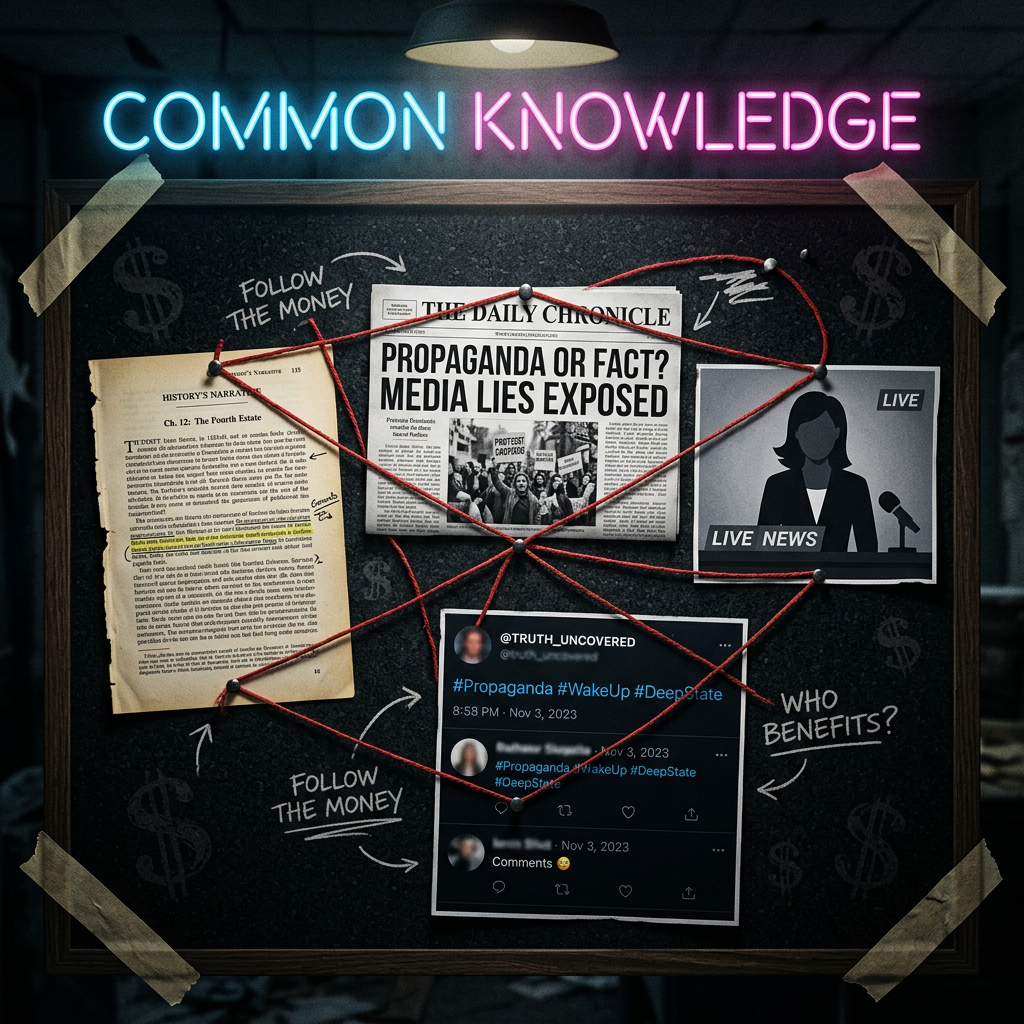
There's a comforting myth we tell ourselves: the truth wins. That if something is wrong, someone will correct it, and if something is right, it will "rise to the top." Like cream. Or like a dead fish.
In reality, "common knowledge" is less like cream and more like a group project: whoever shows up first, talks loudest, and has the biggest budget gets their version stapled to the front of the binder.
What It Is
"Common knowledge" is the stuff we treat as obvious: what's "normal," what's "natural," what's "just how it is." But a lot of it is manufactured—by institutions, incentives, repetition, and the subtle social punishment of being the person who asks, "Wait, says who?"
This explainer breaks down the machinery: how ideas become "facts," how uncertainty gets edited out, and why the most durable beliefs are often the least examined.
The machinery has always existed. But the internet didn't democratize truth—it industrialized the factory.
Why It Matters
- Because policy is built on "obvious truths," and the obvious truths are frequently sponsored. The economist Milton Friedman wasn't just a thinker; he was the figurehead of a decades-long institutional project funded by wealthy libertarian donors to make "free market" ideas feel inevitable. That's not organic consensus. That's carpet bombing dressed up as common sense.
- Because misinformation isn't only conspiracy content; it's also the quiet, respectable kind. A lie from a tabloid is easy to dismiss. A talking point repeated by a credentialed expert in a suit on a reputable platform? That becomes "what smart people think."
- Because if you can't tell the difference between evidence and familiarity, you're easy to steer. And we're all worse at this than we think.
Key Facts
Repetition increases perceived truth ("illusory truth effect"), even when people know better.
When you hear something repeatedly—even if you initially know it's false—your brain starts tagging it as "familiar," and familiar feels like true. This works even when people are explicitly warned about it beforehand.
[Source: Hasher, Goldstein & Toppino, 1977; Unkelbach & Stahl, 2009]
Authority cues (credentials, institutional branding) can override people's evaluation of evidence.
A poorly sourced claim from a doctor in a white coat lands differently than the same claim from a random person. The credentials act like a shortcut: if they're credentialed, I can skip the thinking part. This is why institutional capture—getting the "right" experts to say the "right" things—is so valuable.
[Source: Milgram's obedience studies; Cialdini's authority principle]
Social consensus is a powerful signal; people often infer truth from "everyone says so."
If enough people repeat something, your brain treats it as validated. You don't re-examine the original evidence; you assume others already did. This is called "social proof," and it's weaponizable.
[Source: Asch conformity experiments; Moscovici, 1969]
Media incentives reward clarity and conflict, not uncertainty and nuance.
A journalist saying "we don't know yet" doesn't get clicks. A journalist saying "shocking new evidence suggests X" does. So even good-faith reporting gets shaped by the business model. Nuance is expensive. Certainty is free.
[Source: Media economics research; Sunstein on the attention economy]
Scientific knowledge is provisional; public "science facts" are often simplified, politicized, or frozen in time.
Scientists know this. The public often doesn't. So when a scientific finding gets translated into a headline, it loses its caveats, its uncertainty margins, and its "this is preliminary" disclaimers. What arrives in the public sphere looks more certain than what actually exists in the lab.
[Source: Science communication literature; Moynihan & Cassels on health journalism]
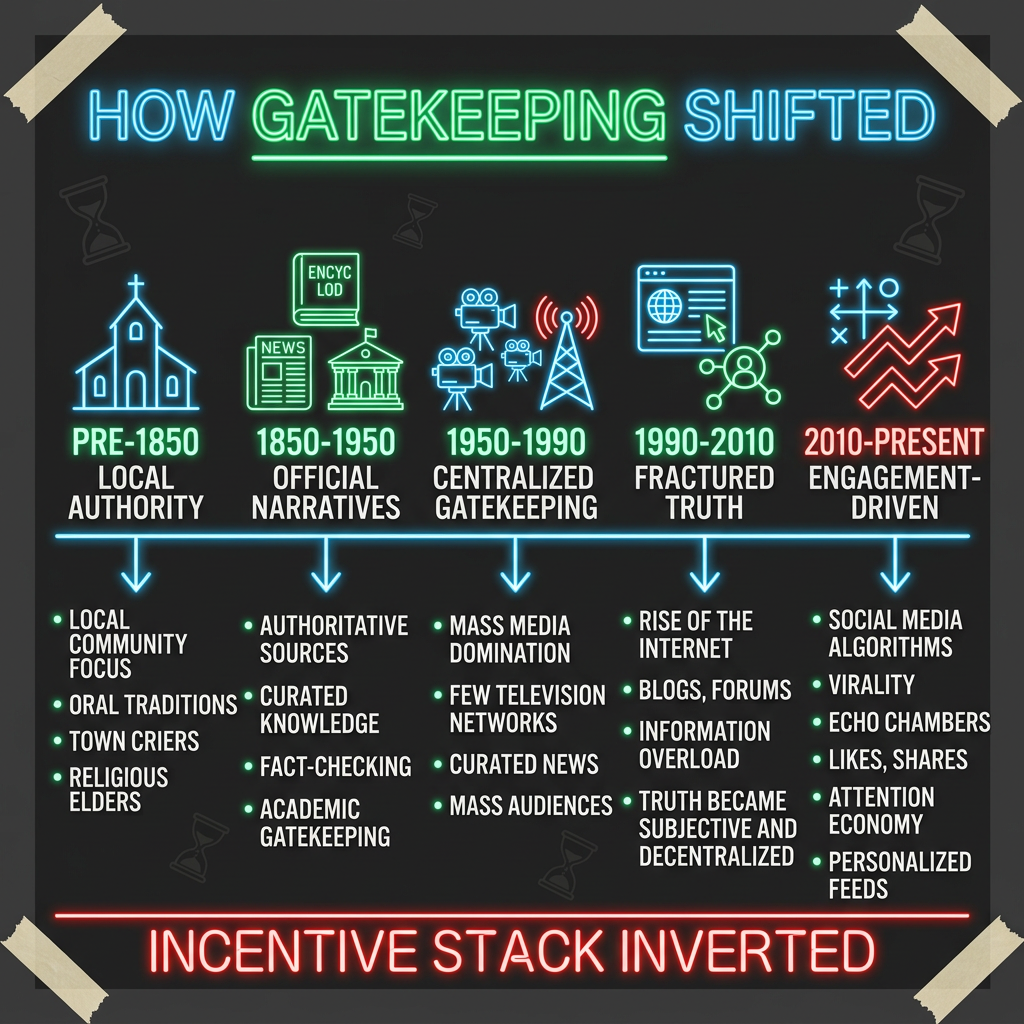
Timeline: How We Got Here
Pre-mass media (pre-1850s)
Knowledge spreads locally; authority is religious, aristocratic, or guild-based. If the priest says so, it's true. No appeal process.
Print + institutions (1850s–1950s)
Encyclopedias, newspapers, and universities create "official" narratives. These institutions consolidate what counts as real. They're not perfect, but they have reputational skin in the game. Getting it wrong hurts them.
Broadcast era (1950s–1990s)
A few gatekeepers (three TV networks, major newspapers) standardize what counts as news. This is less democratic, but it does create a shared factual baseline. There's a cost to being obviously wrong on CBS.
Internet era (1990s–2010s)
Gatekeeping fractures. Anyone can publish. Truth becomes a market problem: whoever can generate engagement wins. Verification becomes optional.
Platform era (2010s–present)
Algorithms reward engagement. "Common knowledge" becomes whatever performs. Certainty outperforms nuance. Outrage outperforms accuracy. The incentive stack is now completely inverted from truth.
So What: Three Patterns to Watch
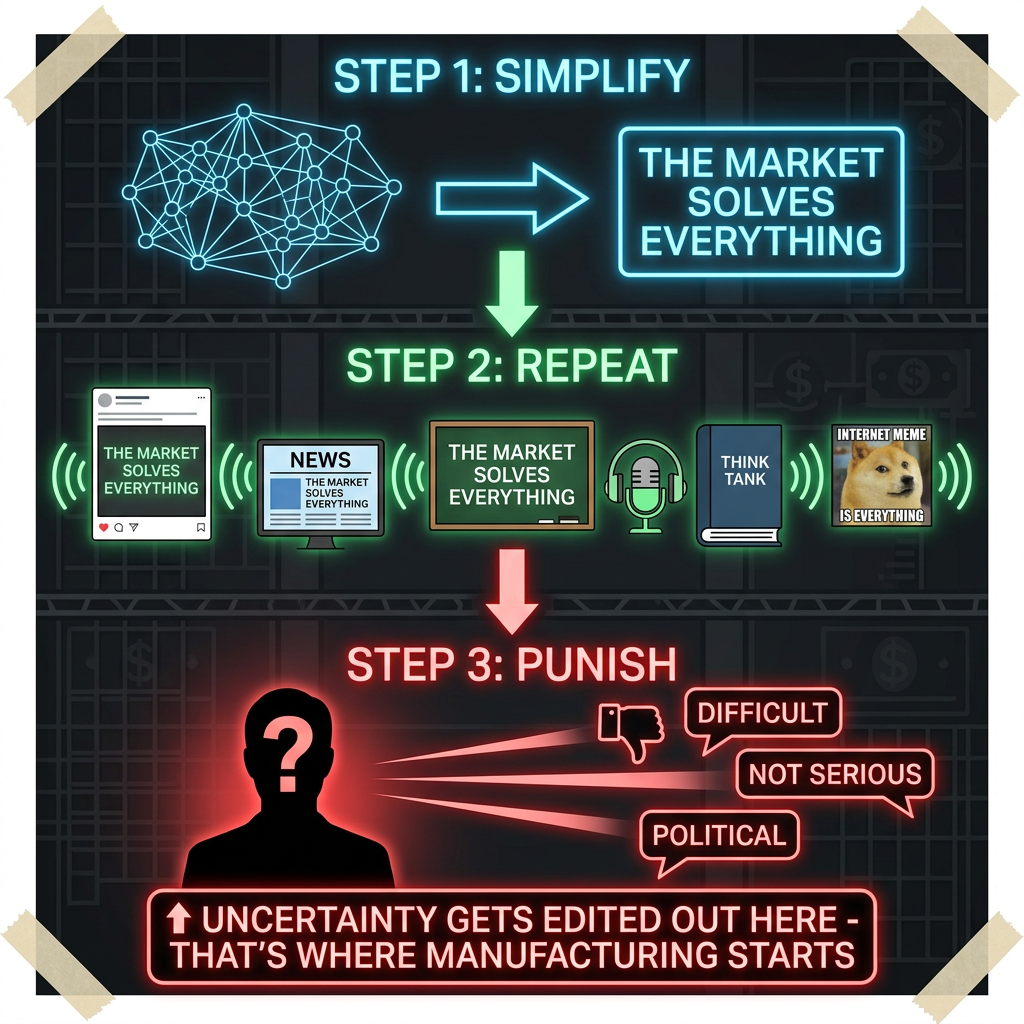
Pattern 1: The Simplify → Repeat → Punish Factory
Simplify: Complex reality gets compressed into a slogan. "The market solves everything" is simpler than "markets solve some things under specific conditions and fail catastrophically under others." Guess which one sticks?
Repeat: The slogan shows up everywhere—headlines, classrooms, think tank reports, memes, policy documents. After enough loops, it stops feeling like an idea and starts feeling like a fact.
Punish: Questioning it makes you "difficult," "political," "not serious," or (increasingly) "not a real scientist/economist/expert." The social cost of doubt becomes higher than the cost of conformity.
Watch for the moment uncertainty gets edited out. That's where the manufacturing starts.
Pattern 2: "Common Knowledge" Loves a Clean Villain
If a story offers one bad guy, one good guy, and a neat moral, it's probably not knowledge—it's content.
Real institutional problems are messy: misaligned incentives, historical accidents, competing interests, unintended consequences. But those don't fit in a headline. So we get culprits instead: the greedy CEO, the lying politician, the shadowy cabal.
Sometimes there really is a villain. But if every "common knowledge" story has one, you should get suspicious.
Pattern 3: The Respectable Version of Misinformation
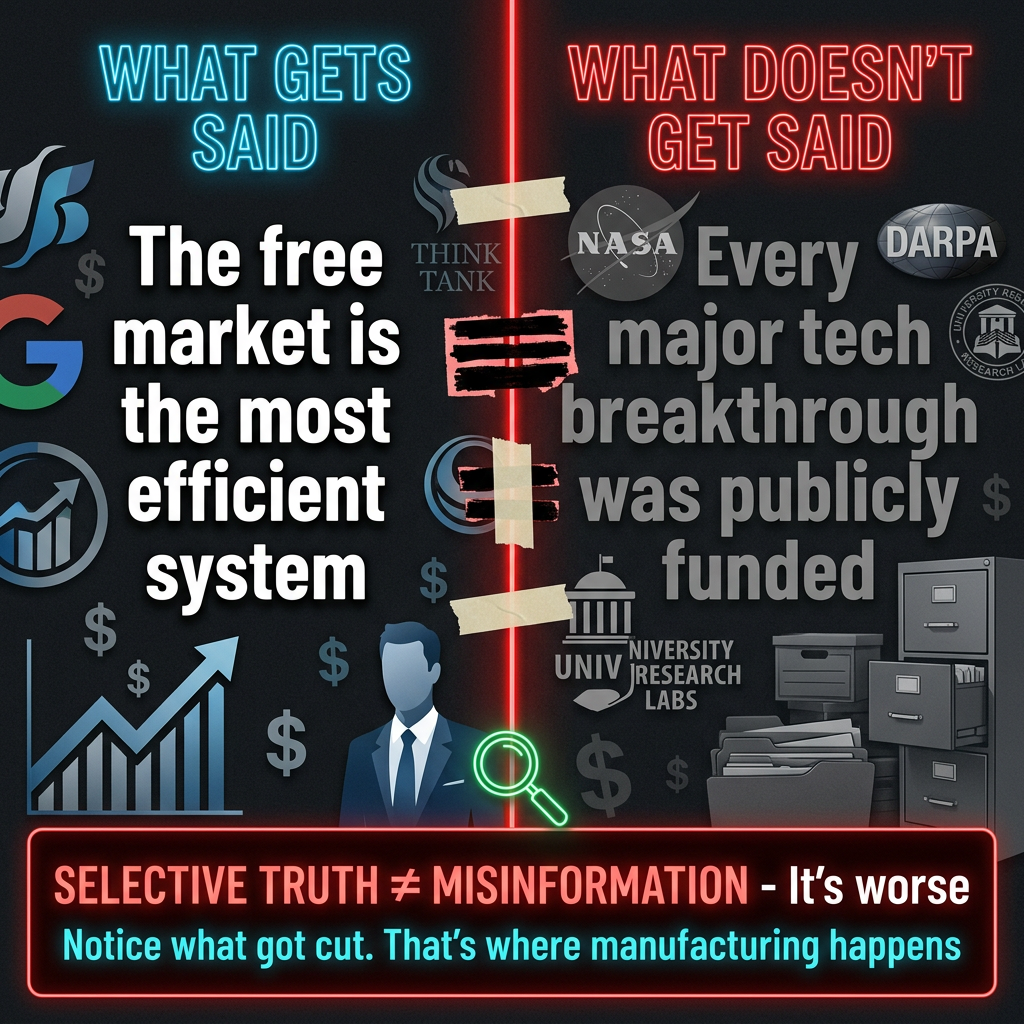
Not everything manufactured is a lie. Some of it is a selection: which facts get highlighted, which get buried, which get framed as "just the way things are."
Example: "The free market is the most efficient system" can coexist with "every major technological breakthrough was publicly funded" if you just... don't mention the second part when explaining the first part.
That's not misinformation in the tabloid sense. It's selective truth dressed up as the whole picture.
Quick test: Ask who benefits if you stop asking questions. If the answer is "a lot of powerful people," you've probably found a piece of manufactured common knowledge.
What to Watch Next
- Follow the funding. Ideas that get underwritten by wealthy institutions tend to become "obvious." Follow the money to see which truths are actually subsidized.
- Notice when certainty appears. Real experts hedge. When someone is absolutely certain about something complex, ask why. The certainty might be confidence. It might also be marketing.
- Look for the caveats that disappeared. Find the original research. Then find the news story. Notice what got cut. Those deletions are where the manufacturing happens.
Sources
- Hasher, L., Goldstein, D., & Toppino, T. (1977). "Frequency and the conference of referential validity." Journal of Verbal Learning and Verbal Behavior, 16(1), 107-112.
- Unkelbach, C., & Stahl, C. (2009). "A mere exposure effect for nonvisual stimuli: The mere exposure effect for auditory stimuli." Psychonomic Bulletin & Review, 16(4), 689-693.
- Cialdini, R. B. (2009). Influence: Science and Practice (5th ed.). Pearson Education.
- Moscovici, S. (1969). "Social influence and social change." Academic Press.
- Sunstein, C. R. (2002). Republic.com: Dealing with Extremism in the Age of Infotainment. Princeton University Press.
- Moynihan, R., & Cassels, A. (2005). Selling Sickness: How the World's Biggest Pharmaceutical Companies Are Turning Us All Into Patients. Nation Books.