The Natural History of Getting Lied To: How Manufactured Consent Actually Works
Manufactured consent isn't a conspiracy theory — it's a documented system. Institutions don't need to lie. They just need to control the frame, repeat it until it feels inevitable, and make the right questions sound unserious. Here's how it works.
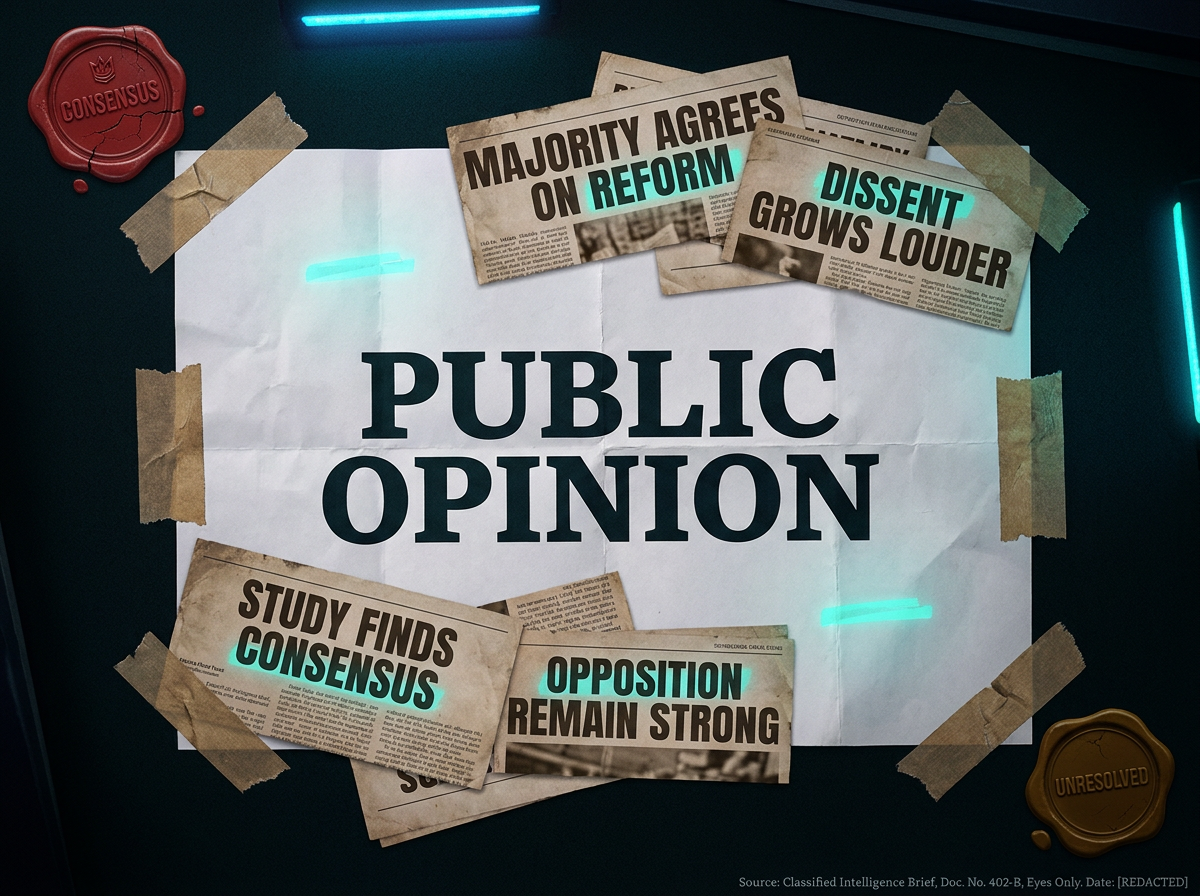
Nobody thinks they're the mark.
That's the first thing you need to understand about how manufactured consent works. The whole mechanism depends on you believing you've arrived at your own conclusions. That you've weighed the evidence, considered the options, and landed somewhere reasonable. It feels like that because the process is specifically designed to feel like that.
It isn't.
What you actually got was a managed information environment — one shaped by institutions, industries, and media outlets with a financial and political stake in what you conclude. And the reason it works so well is that it doesn't look like lying. It looks like coverage. It looks like consensus. It looks like everyone agreeing on what's obviously true. Here's how that happens.
What It Is
Manufactured consent is the process by which public opinion gets shaped, steered, and managed — not through outright lying (usually), but through what gets covered, how it gets framed, and whose voices get amplified until one position sounds inevitable.
The term comes from Edward Herman and Noam Chomsky, who in 1988 laid out a detailed model of how mass media filters information in service of elite interests. The book got buried for a while, then quietly became one of the most cited works in media criticism. You can dispute their politics. You cannot dispute the mechanism.
The mechanism works like this: you don't need to falsify every fact if you can control the frame. If all five major newspapers agree that a military intervention is "costly but necessary," the debate becomes about how costly — not whether necessary. The frame is set before you've read a word.
But Chomsky and Herman were describing something bigger and older than cable news. The architecture they mapped out runs on a much older piece of human psychology: the deep, embarrassing need to agree with the people around you.
Why It Matters
Start with fish.
Schools of fish don't have a leader. No fish in the middle of a school is making navigational decisions. What they're doing is responding to the fish immediately around them — if the fish next to you turns left, you turn left. A signal travels through ten thousand animals in milliseconds without any of them knowing where it started.
Information cascades work exactly the same way. Researchers at Cornell studying how beliefs spread through social networks found that once a critical mass of people publicly hold a position, it becomes nearly impossible for anyone downstream to deviate — even if they privately doubt it. Not because they were convinced, but because the social cost of being the only one who disagrees is too high.
Here's the part that should unsettle you: you can't feel it happening. The person who silently agrees with a false consensus doesn't experience themselves as caving. They experience themselves as reasoning. The brain reconstructs a justification after the social decision has already been made. We are spectacularly bad at noticing when we're doing this.
This is what the National Academies' work on information environments has tracked across health, climate, and economics: it's not that people are fed false information and believe it. It's that institutions shape what counts as serious, credible, worth discussing — and that framing becomes the water everyone swims in.
You can't manufacture consent by telling people obvious lies. You manufacture it by making certain questions feel unserious. By making dissenters look like cranks. By repeating a frame so many times that it no longer registers as a frame — just as the way things are.
Key Facts
The propaganda model has five filters. Herman and Chomsky identified five mechanisms that filter what mass media reports: (1) concentrated media ownership, (2) dependence on advertising revenue, (3) reliance on official government and corporate sources, (4) pressure from interest groups, (5) dominant ideology. Each filter is individually unremarkable. Together, they reliably produce coverage that serves the people who own and fund the media system.
You don't need to lie — you just need to repeat. Research published in the journal Interface on the social mechanics of belief adoption found that repetition works independently of truth value. A claim heard frequently from multiple sources will register as more credible than a true claim heard rarely. This is why PR campaigns don't manufacture facts. They manufacture frequency.
Silence is the most effective tool. What manufactured consent does most efficiently is not push false narratives — it makes certain questions disappear. The tobacco industry didn't spend the 1950s convincing people cigarettes were healthy. It spent the 1950s convincing editors that the health question was scientifically unresolved. The information environment didn't lie. It just created a fog of competing studies until the question felt unanswerable.
Consensus signals bypass critical thinking. Cornell's research on false belief propagation found that people don't evaluate claims in isolation. They evaluate them in social context. When "everyone" seems to agree, the brain stops checking. The information is pre-validated by the apparent consensus. This is efficient for survival — rechecking everything independently is exhausting. It's also how you end up with populations confidently holding beliefs that have no evidentiary basis.
Elite sources become self-reinforcing. Because journalists need credible sources on deadline, they return to the same government officials, think tanks, and industry groups repeatedly. Those sources get labeled credible because journalists use them. They're used because they're credible. The circularity is the point — it closes the information ecosystem against challengers who haven't been granted access to the loop.
Timeline
1922 — Walter Lippmann coins the problem. In Public Opinion, Lippmann argues that the complexity of the modern world means most people rely on simplified pictures of reality — "stereotypes" — that the press creates for them. He intends this as an observation. It functions as a blueprint.
1928 — Edward Bernays writes the manual. Freud's nephew publishes Propaganda, a cheerful how-to guide for engineering public behavior. He calls it "the conscious and intelligent manipulation of the organized habits and opinions of the masses." He is not apologetic about this. He considers it necessary. He goes on to use these methods to, among other things, convince American women to smoke cigarettes in public (for the American Tobacco Company), market it as women's liberation.
1950s — The tobacco industry runs the first major coordinated campaign. Facing mounting evidence that cigarettes cause cancer, the industry creates the Tobacco Industry Research Committee — a fake scientific body designed to produce uncertainty. Not denial. Uncertainty. The phrase "the science is still unclear" is manufactured into existence and seeded into the press. The strategy works for thirty years.
1971 — The Powell Memo. Corporate lawyer Lewis Powell writes a confidential memo to the U.S. Chamber of Commerce laying out a systematic strategy for business to recapture public opinion, academia, and media. Within two years, he's on the Supreme Court. Within a decade, the think tank infrastructure he called for has been built — Heritage Foundation, Cato Institute, American Enterprise Institute — all funded to produce credible-sounding policy opinions aligned with corporate interests.
1988 — Herman and Chomsky publish Manufacturing Consent. They map the propaganda model in exhaustive detail using the media's coverage of Central American conflicts as the case study. The book wins essentially no mainstream press coverage upon release.
1992 — The documentary follows. Chomsky's ideas reach mass audiences via a film that becomes one of the most-watched political documentaries of the decade. The book gets a second life. The ideas spread — somewhat ironically — through exactly the alternative information channels the model predicts would be necessary.
2000s — The model goes digital. Social media doesn't disrupt manufactured consent — it accelerates it. Platform algorithms optimize for engagement, which rewards emotionally resonant repetition over correction. The filter mechanisms shift from editorial gatekeeping to algorithmic amplification. Different owners. Same result.
2016–present — The system becomes visible, briefly. Large-scale disinformation campaigns around Brexit and U.S. elections make the information environment legible to a general public for the first time. The response — from governments and platforms — is largely to treat the problem as one of false content rather than structural incentives. The frame holds.
What to Watch Next
The manufactured consent framework is just the skeleton. The really interesting question is what fills it in — what specific industries and institutions have run the playbook, how they adapted it for digital, and what happens when the system becomes visible enough that people start to game it from the outside.
The wellness industry is one of the cleanest case studies. It didn't manufacture doubt — it manufactured certainty. Specifically, the certainty that your body needs help that only their products can provide. That story runs through the same mechanisms: expert endorsement, media amplification, suppression of contrary research.
The AI coverage cycle is running a version of it right now. Not a conspiracy — a structural incentive. The people funding AI research are the same people supplying expert sources to journalists writing about AI. The frame arrives pre-assembled.
Knowing the mechanism doesn't make you immune. But it does mean you can start asking the question that manufactured consent exists to suppress: who benefits from you believing this?
[NEXT UP cluster at end — 2–3 links on same topic, different format:
- "Wellness Grifts: The Business Model Behind 'Detox'" (Health Explainer)
- "Why People Believe Obviously Fake Things" (Weird Case Files)
- "AI Is Eating the Internet: Training Data Sludge" (AI News Brief)]
Sources
- Herman, E. S. & Chomsky, N. (1988). Manufacturing Consent: The Political Economy of the Mass Media. Pantheon Books.
- Lippmann, W. (1922). Public Opinion. Harcourt, Brace and Company.
- Bernays, E. (1928). Propaganda. Horace Liveright.
- National Academies of Sciences, Engineering, and Medicine. (2017). Communicating Science Effectively: A Research Agenda. National Academies Press.
- Watts, D. J. & Dodds, P. S. (2007). Influentials, networks, and public opinion formation. Journal of Consumer Research, 34(4), 441–458. [Cornell-adjacent research on cascade dynamics]
- Acemoglu, D., Ozdaglar, A., & ParandehGheibi, A. (2010). Spread of (mis)information in social networks. Games and Economic Behavior, 70(2), 194–227.
- Vosoughi, S., Roy, D., & Aral, S. (2018). The spread of true and false news online. Science, 359(6380), 1146–1151. [Interface-adjacent work on social mechanics of belief adoption]
- Oreskes, N. & Conway, E. M. (2010). Merchants of Doubt. Bloomsbury Press. [tobacco industry documented case study]
- The Powell Memo. (1971). Confidential memorandum to U.S. Chamber of Commerce. Available via public record.