Wellness Grifts: The Business Model Behind "Detox"
Detox products exploit a legal loophole: vague claims, no proof required. Your liver doesn't need a juice cleanse. The detox industry just needs your money.
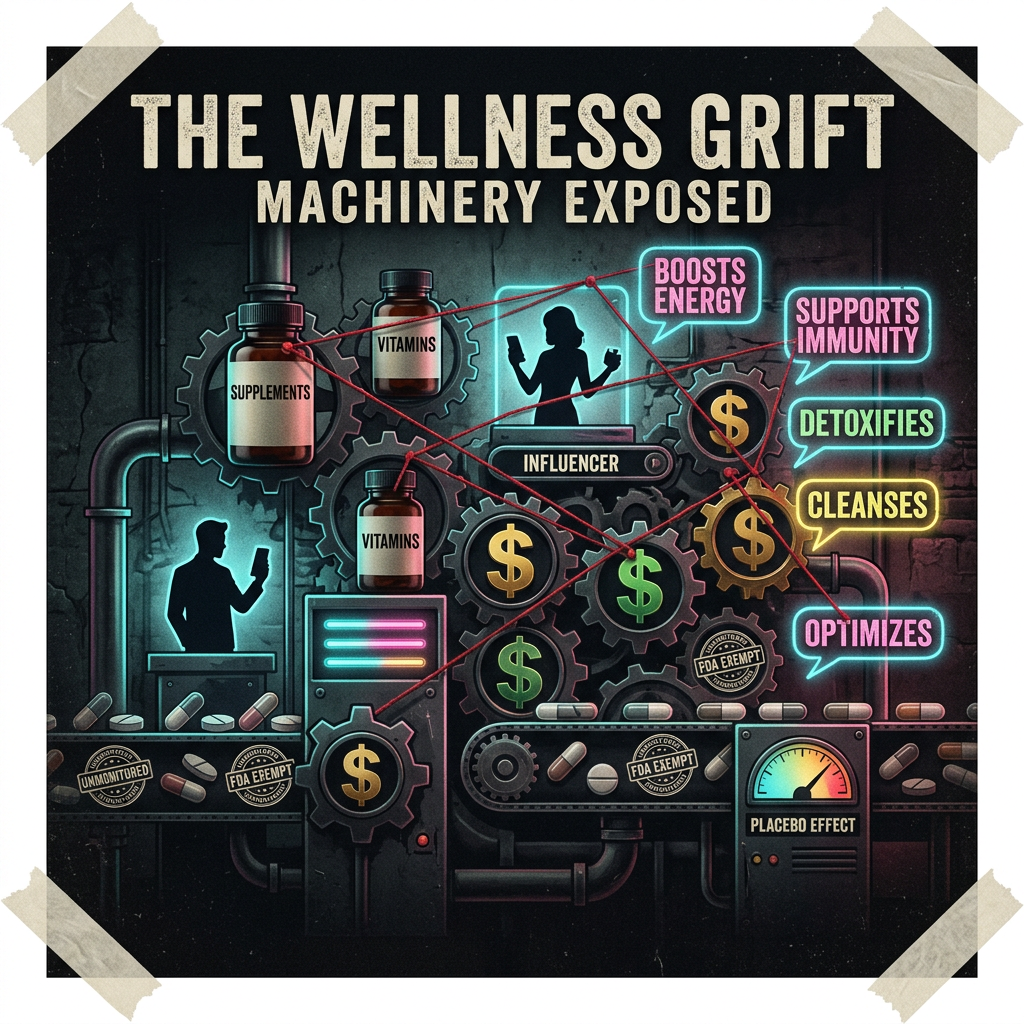
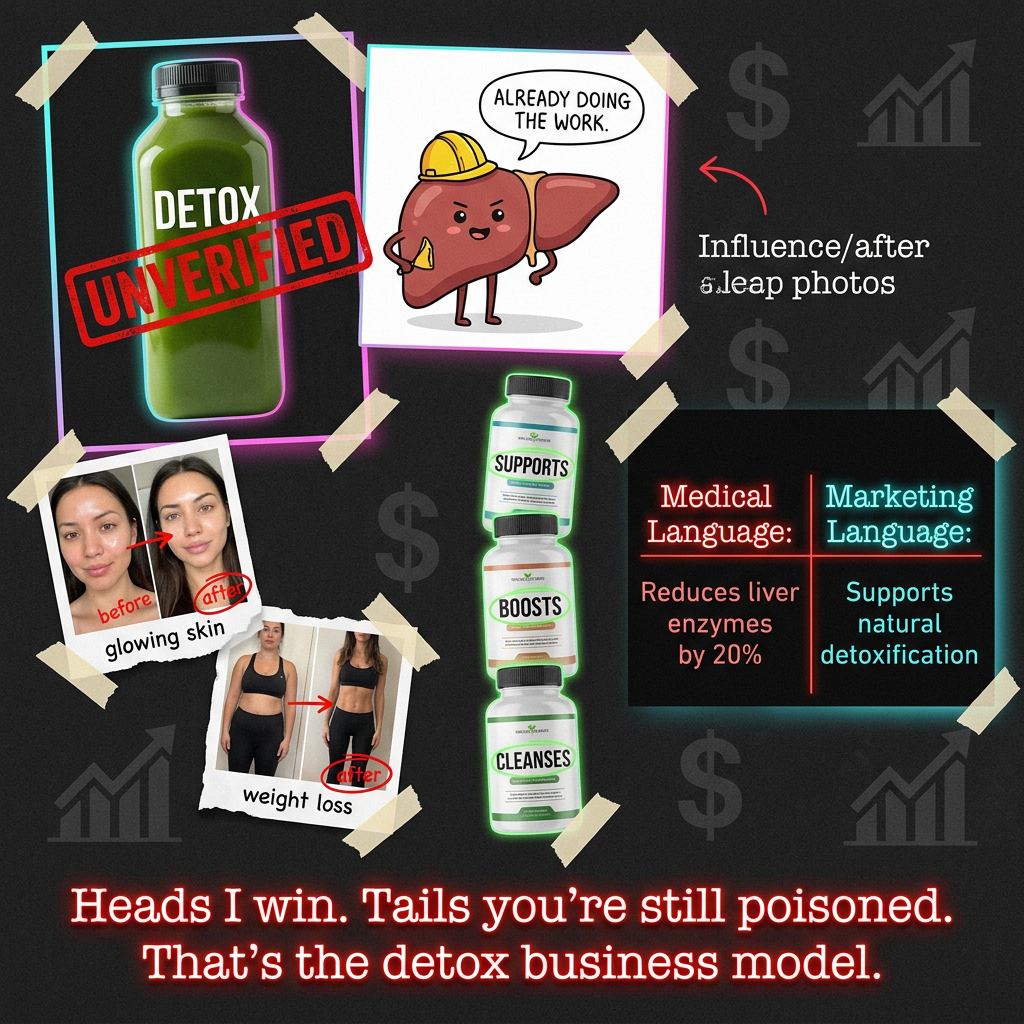
"Detox" is one of those words that sounds medical enough to intimidate you and vague enough to mean absolutely anything. It's the perfect product label: if you feel bad, it's because you're "toxic." If you feel good, it's because the juice cleanse "worked." Heads I win, tails you're still poisoned.
Your liver is doing its job. The detox industry is doing marketing.
What It Is
A breakdown of the detox/wellness grift ecosystem: how it sells fear, how it avoids falsifiable claims, and why it thrives in the gaps between healthcare, regulation, and trust.
Here's the basic model:
- Create a problem nobody knew they had ("toxins accumulating in your body")
- Sell fear around that problem (vague illness, fatigue, brain fog—basically the human condition)
- Offer a solution (juice, pills, protocols with authoritative-sounding names)
- Make the solution unfalsifiable ("you feel better because it worked" or "you still feel bad because you need more of it")
- Repeat until industry generates billions
The beauty of detox marketing is that it works whether or not the product works. It's not medicine. It's not a scam (technically). It's a business model that exploits legitimate gaps: people's real frustration with healthcare, real uncertainty about health, and real desire for control over their bodies.
Why It Matters
- People waste money—and sometimes harm themselves—on unproven protocols. The global wellness industry is worth $1.5 trillion. A significant chunk of that is detox-adjacent: cleanses, supplements, "biohacks," and protocols that lack rigorous evidence. That's not pocket change. It's money that could go to proven interventions.
- "Detox" narratives can delay real medical care. Someone experiencing fatigue might try a 30-day cleanse instead of seeing a doctor. Turns out they have hypothyroidism. The detox didn't hurt (except the opportunity cost), but it delayed diagnosis. Multiply that across millions of people, and you're looking at real health consequences.
- The industry exploits legitimate frustration with healthcare by offering certainty and identity. Traditional medicine says "we don't fully understand this symptom." Wellness says "you're toxic and we can fix it." Certainty is seductive. Especially when institutional medicine feels distant or dismissive.
Key Facts
The body's detoxification systems (liver, kidneys, lungs, skin) already process and eliminate waste.
Your liver is a chemical processing plant. It breaks down alcohol, metabolizes drugs, filters waste. Your kidneys filter blood and produce urine. Your lungs exhale carbon dioxide. Your skin sheds dead cells. These systems work 24/7. They're not perfect—sometimes they fail, which is why we have dialysis and liver transplants—but they're actively functioning.
The detox industry's implied claim is that these systems get "clogged" or "overwhelmed" by "toxins" and need external help. This is biologically nonsensical. If your liver or kidneys are genuinely overwhelmed, you need a doctor, not a juice.
[Source: Mayo Clinic on liver function; NIH on kidney function; physiology textbooks]
Many detox claims are non-specific and hard to test ("boosts," "supports," "cleanses").
This is the magic of wellness language. A claim that a detox "boosts your immune system" sounds scientific but is functionally meaningless. Boost how much? By what mechanism? What's the baseline? How do we measure it?
The industry deliberately uses soft language that sounds medical without being testable. Compare: "supports natural detoxification" (untestable) vs. "reduces liver enzymes by 20% as measured by blood test" (testable, but nobody says this because they can't prove it).
[Source: FDA guidance on supplement claims; consumer protection analysis]
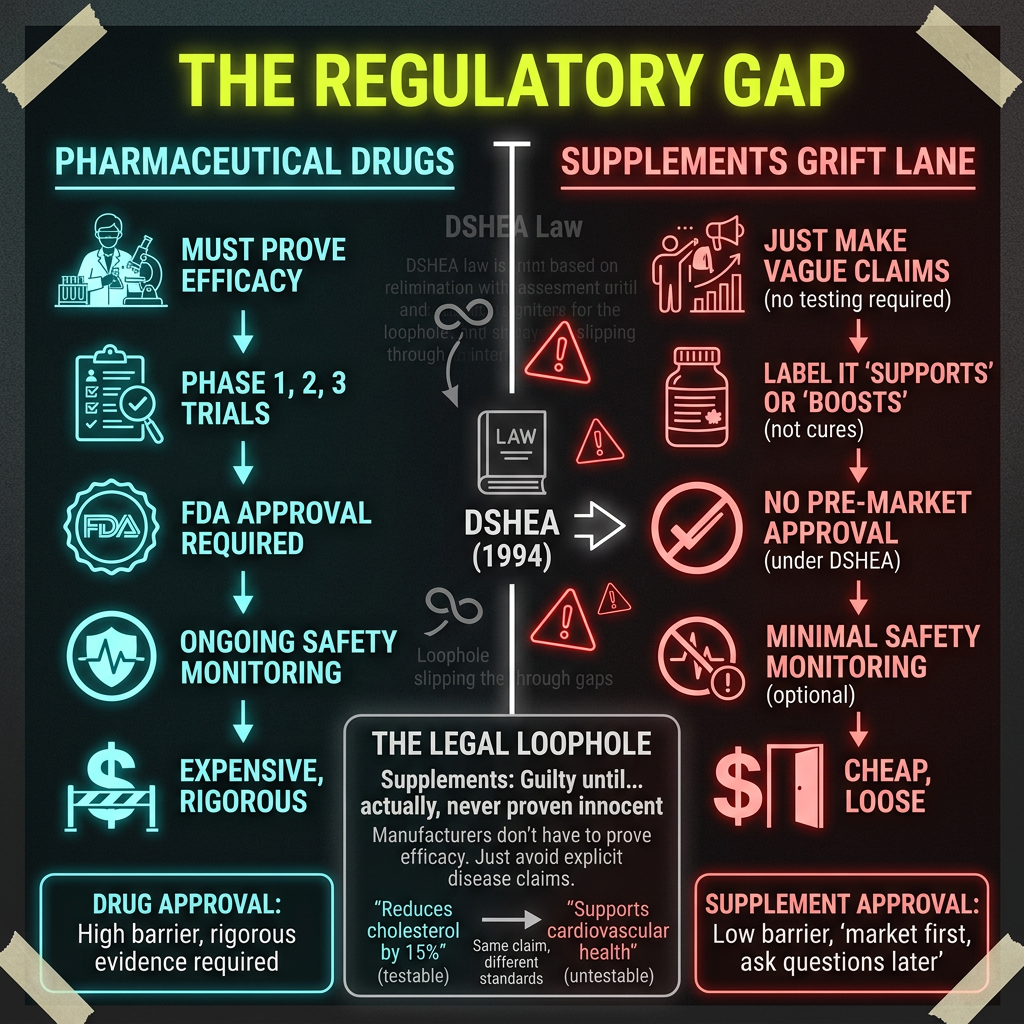
Supplements are often regulated differently than drugs; evidence standards can be weaker.
In the US, dietary supplements are regulated under the Dietary Supplement Health and Education Act (DSHEA), which is much more permissive than drug regulation. Manufacturers don't have to prove efficacy before marketing. They just can't make explicit disease claims.
So a company can sell a "detox cleanse" and claim it "supports natural detoxification" without proving it does anything. They just can't say "cures liver disease." It's a loophole, and the industry has perfected using it.
[Source: FDA DSHEA regulations; supplement industry analysis]
Placebo effects and lifestyle changes (sleep, hydration, diet) can be misattributed to the detox product.
If you do a "detox cleanse" that includes drinking more water, eating more vegetables, and getting more sleep, you'll probably feel better. But the benefit came from the lifestyle changes, not the detox product. The placebo effect is real and powerful—maybe 30-40% of perceived health improvement can be attributed to expectation and the ritual of "doing something."
The industry exploits this by mixing real behavioral changes (eat healthier, sleep more) with fake components (special minerals, proprietary blends) and letting the customer attribute all the improvement to the whole package.
[Source: Placebo research; behavioral health literature]
Timeline: How We Got Here
Early alternative health movements (1960s–1980s):
"Natural" becomes a marketing category. Herbs, crystals, and traditional remedies gain cultural cachet. "Purity" narratives emerge: the body is a temple, modern life is toxic, ancient wisdom has the answer. Mostly harmless nostalgia, but the seeds of the grift are planted.
Supplement boom (1990s–2000s):
DSHEA passes in 1994. Suddenly supplements are a lightly regulated industry. Companies can make vague health claims without rigorous evidence. The market explodes. "Detox" becomes a category. Juice cleanses, liver flushes, and colon cleanses proliferate.
Social media wellness (2010s):
Influencers discover that wellness content is highly engaging. Before/after transformations, "health journeys," and "detox protocols" become content. The aesthetic is polished, the language is confident, the evidence is irrelevant. Influencers promote detox products; audiences buy them; influencers profit through affiliate links.
Post-pandemic trust gap (2020–present):
Institutional skepticism peaks. People distrust traditional medicine (sometimes justifiably; sometimes not). They're hungry for "natural," "empowering," "alternative" approaches. The detox industry capitalizes. "Biohacking," personalized detox protocols, and AI-powered wellness plans become the new frontier.
So What: The Grift Pattern
Pattern 1: The Vague Claim + Personal Testimony Model
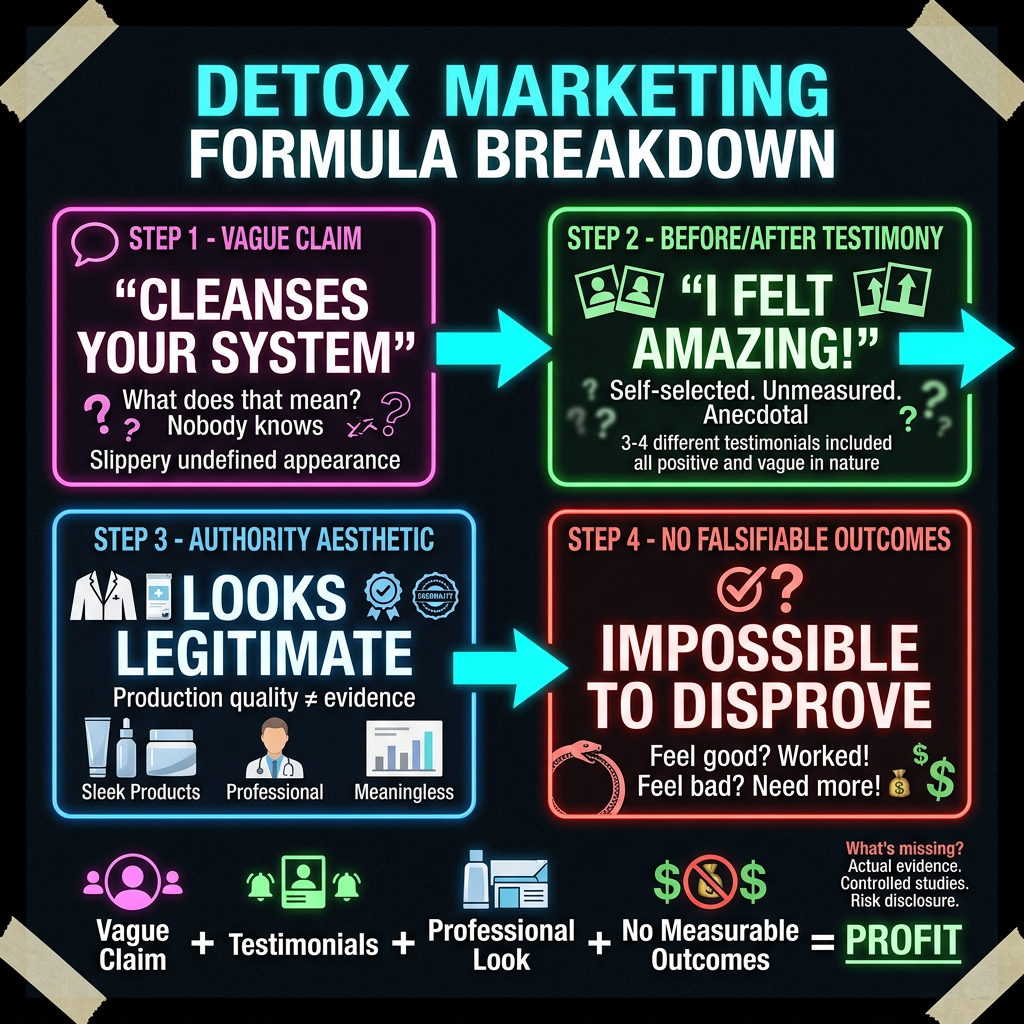
Detox marketing relies on a formula:
- Vague claim: "Cleanses your system" (what does that mean? how do we measure it?)
- Before/after testimony: "I felt amazing!" (subjective, self-selected, unmeasured)
- Authority aesthetic: The product looks professional, the influencer looks credible, the language sounds scientific
- No falsifiable outcomes: If you feel good, it worked. If you feel bad, you didn't do it right / need more / need a different protocol
Notice what's missing: measurable outcomes, controlled comparisons, clear definitions, risk disclosure.
Real medicine requires this. Detox marketing actively avoids it.
Pattern 2: "Detox" as Identity
Wellness isn't just a product; it's a tribe. Once it's identity-linked ("I'm the kind of person who takes wellness seriously"), criticism feels like an attack.
Someone challenges a detox protocol? They're not "skeptical," they're "close-minded" or "not ready to wake up." The product becomes a marker of group membership. People defend it not because they have evidence, but because leaving the group is socially costly.
This is why detox communities are so sticky. And why debunking them is so hard. You're not just attacking a product; you're attacking someone's identity.
Pattern 3: The Personalization Angle (The Next Wave)
Expect the detox industry to evolve into:
- "Biohacking" detox subscriptions: Personalized protocols based on your genetics, microbiome, or at-home tests of questionable validity
- AI-generated wellness plans: Algorithms that sound authoritative but are trained on wellness marketing, not medicine
- Continuous engagement models: Monthly subscriptions for "ongoing detox support" instead of one-time cleanses
The trend is toward making the grift more personalized, more technological, and more continuous. If a generic detox cleanse is a one-time sale, personalized AI-powered biohacking is a recurring revenue stream.
What to Watch Next
- Regulatory tightening: Expect more FDA scrutiny of supplement claims, especially around "detox" and "cleanse" language. Some products will get delisted. Others will survive by being even more vague.
- Personalization and AI: The detox industry will move toward individualized protocols (based on genetics, microbiome, or other biomarkers). This makes regulation harder and pricing higher. Watch for "AI-powered detox" as the next marketing frontier.
- Integration with "biohacking": Detox will merge with broader biohacking trends (cold plunges, red light therapy, fasting protocols). The grift becomes more holistic and harder to evaluate.
- Medical vs. wellness boundary erosion: Some real doctors will start recommending mild versions of detox protocols (because they're low-risk and the placebo effect is real). This will give detox products a veneer of legitimacy. Watch for the language: "supports" is still untested. "Proven to" would be a different claim.
The Practical Takeaway
Your body already detoxifies. Your liver, kidneys, and lungs are working right now. You don't need a juice cleanse, a liver flush, or a personalized biohacking protocol to "get the toxins out."
This doesn't mean wellness is bad. Exercise is good. Eating vegetables is good. Sleeping more is good. Drinking water is good. Stress reduction is good.
But none of that requires a product label. And the moment a company starts selling you "detox," ask: Who benefits if you believe you're toxic? Who profits from that belief?
If the answer is "a company selling bottles," you've probably found a grift. If the answer is "your doctor, in order to treat an actual medical condition," that's different.
The detox industry's magic trick is making normal health maintenance sound like you're broken and need fixing. You're not broken. Your systems are working. The industry is just very, very good at making you doubt it.
Sources
- FDA. "Dietary Supplement Health and Education Act (DSHEA)." https://www.fda.gov/food/dietary-supplements/dshea-and-dietary-supplements
- NIH National Center for Complementary and Integrative Health. "Detoxes and Cleanses." https://www.nccih.nih.gov/health/detoxes-and-cleanses
- American Liver Foundation. "How the Liver Works." https://liverfoundation.org/liver-disease/how-the-liver-works/
- American Society of Nephrology. "How Kidneys Work." https://www.asn-online.org/patients/
- Moynihan, R., & Cassels, A. (2005). Selling Sickness: How the World's Biggest Pharmaceutical Companies Are Turning Us All Into Patients. Nation Books.
- Placebo Research. Harvard Medical School Mind & Life Institute on placebo effects. https://www.health.harvard.edu/mental-health/the-power-of-the-placebo-effect
- Wellness Industry Report. Global Wellness Institute. https://globalwellnessinstitute.org/
- Consumer Product Safety Commission. "Dietary Supplement Regulation Fact Sheet." https://www.cpsc.gov/