When "Review" Becomes Energy Policy
The Trump administration didn't pass a law killing renewable energy. It just made renewable energy wait. Here's how a bureaucratic process became the most effective energy policy no one voted on.
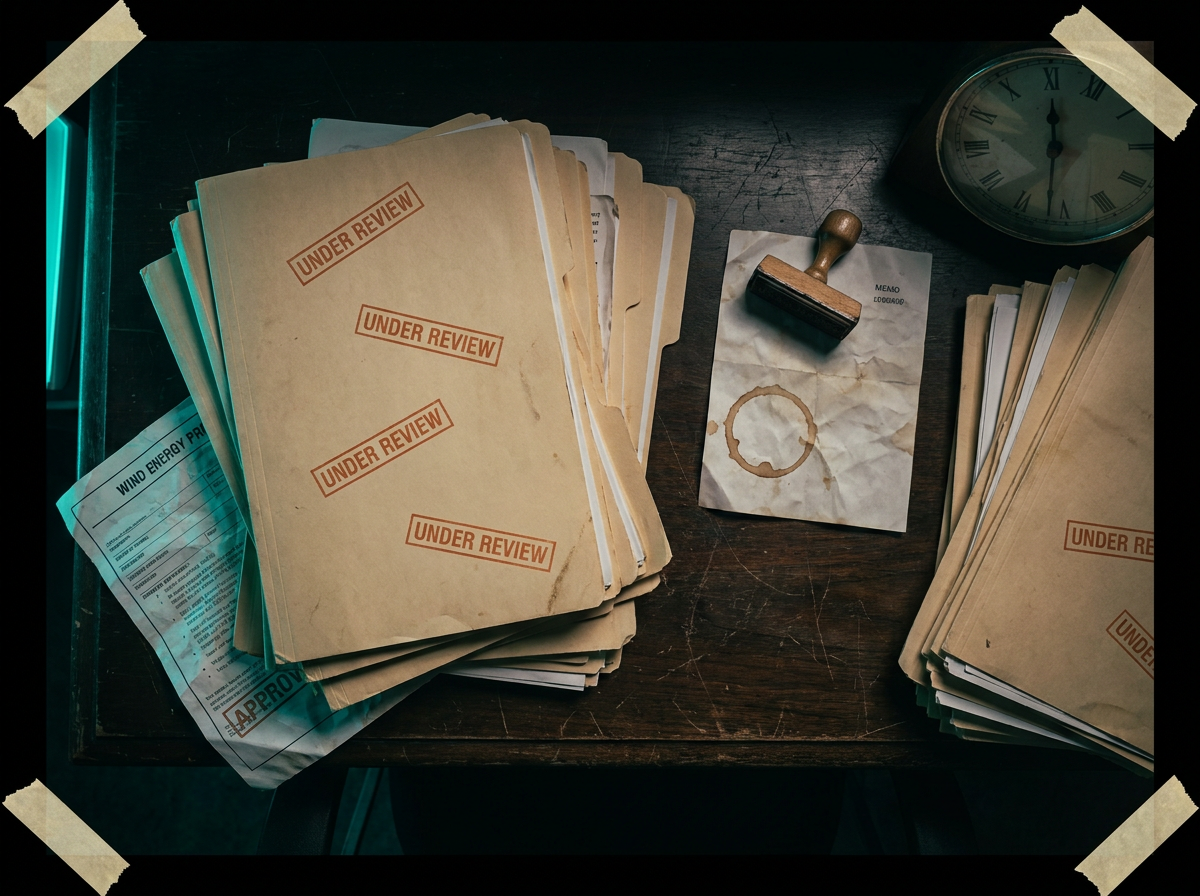
The Trump administration didn't pass a law killing renewable energy. It didn't need to. It just made renewable energy wait.
In July 2025, the Interior Department issued a memo requiring Doug Burgum's office to personally review more than 68 types of agency actions before any wind or solar project can move forward — permits, environmental reviews, lease sales, site plans, and wildlife impact assessments. All of it. The official framing was "ending preferential treatment for unreliable, subsidy-dependent wind and solar energy." The practical effect was that the process runs in one direction. Oil, coal, gas, and nuclear got easier and cheaper to approve. Wind and solar got a new layer of scrutiny with no defined timeline and no clear off-ramp.
This is how you kill an industry without a vote. The Jackalope Wind project — a wind farm the size of Chicago in Wyoming, with a 35-year utility contract signed a week before the 2024 election — is now effectively dead after months of stalled environmental review. More than 60 large wind and solar farms on federal lands are similarly stymied. Hundreds more on private land face potentially fatal delays, because even projects that never touch federal property often need federal consultations for wildlife protections. The bureaucratic choke point doesn't care where the land title sits.
Meanwhile, solar installations fell 14 percent in 2025 compared to 2024. The Energy Department cut hundreds of millions from renewable programs. And the energy secretary — Chris Wright, a former oil and gas executive — stood at CERAWeek and said, on the record: "Beyond the obvious scale and cost problems, there is simply no physical way wind, solar and batteries could replace the myriad uses of natural gas." That's not analysis. That's a policy position delivered in the language of physics. This is what industrial policy by administrative inertia looks like.
China installed three times as much wind capacity as the rest of the world combined last year — and now controls all six of the world's largest wind turbine manufacturers. GE, Vestas, Enercon, Gamesa, Suzlon: all displaced. China ran the same playbook the US wrote for semiconductors, then forgot. A 2005 domestic content requirement forced foreign companies to train hundreds of Chinese suppliers. Those suppliers then supplied domestic competitors. Gamesa's market share collapsed from 30 percent to 3 percent. The US is now paying energy companies nearly $2 billion to abandon offshore wind plans.
The administration stalled 150-plus wind farm projects by delaying routine military airspace reviews — reviews that were previously considered a formality. Not a new law. Not a regulatory rollback. Just a review that used to take weeks and now doesn't happen. That's the architecture of the strategy: find the administrative choke points, and stop clearing them. The word "review" is doing the policy work.
Global wind turbine orders surged 40 percent last year, driven partly by the oil price spike following US and Israeli attacks on Iran. The rest of the world is accelerating. Xi Jinping, in March 2026: "Energy is a strategic issue in development — our pioneering development of wind power and solar technology has proved to be forward-looking." China's wind turbine exports to the EU jumped 66 percent. Belt & Road shipments up 74 percent. Britain blocked a Chinese firm from installing offshore turbines on national security grounds. Everyone is treating this as the strategic competition it is — except the country that invented the modern wind industry. The framing that wind and solar are 'unreliable' and 'subsidy-dependent' is doing exactly the work it was designed to do.
Next up:
More to come on breaking events in the China mine explosion and the Toxic Chemical Tank in Orange County.
Sources
- Brad Plumer, "Interior Dept. Memo Requiring Review of Wind and Solar Projects," New York Times, July 2025
- Brad Plumer and Rebecca F. Elliott, "Trump Blockade Stymies Wind and Solar Projects," New York Times, February 2026
- Ivan Penn, "Solar Installations Fell 14% in 2025," New York Times, March 2026
- Keith Bradsher, "China's Wind Dominance," New York Times, May 2026