AI Is Eating the Internet: What Happens When the Web Becomes Training Data Sludge?
AI is filling the web with low-quality synthetic content. Models trained on AI text get worse. Publishers spam to survive. The internet is eating itself.
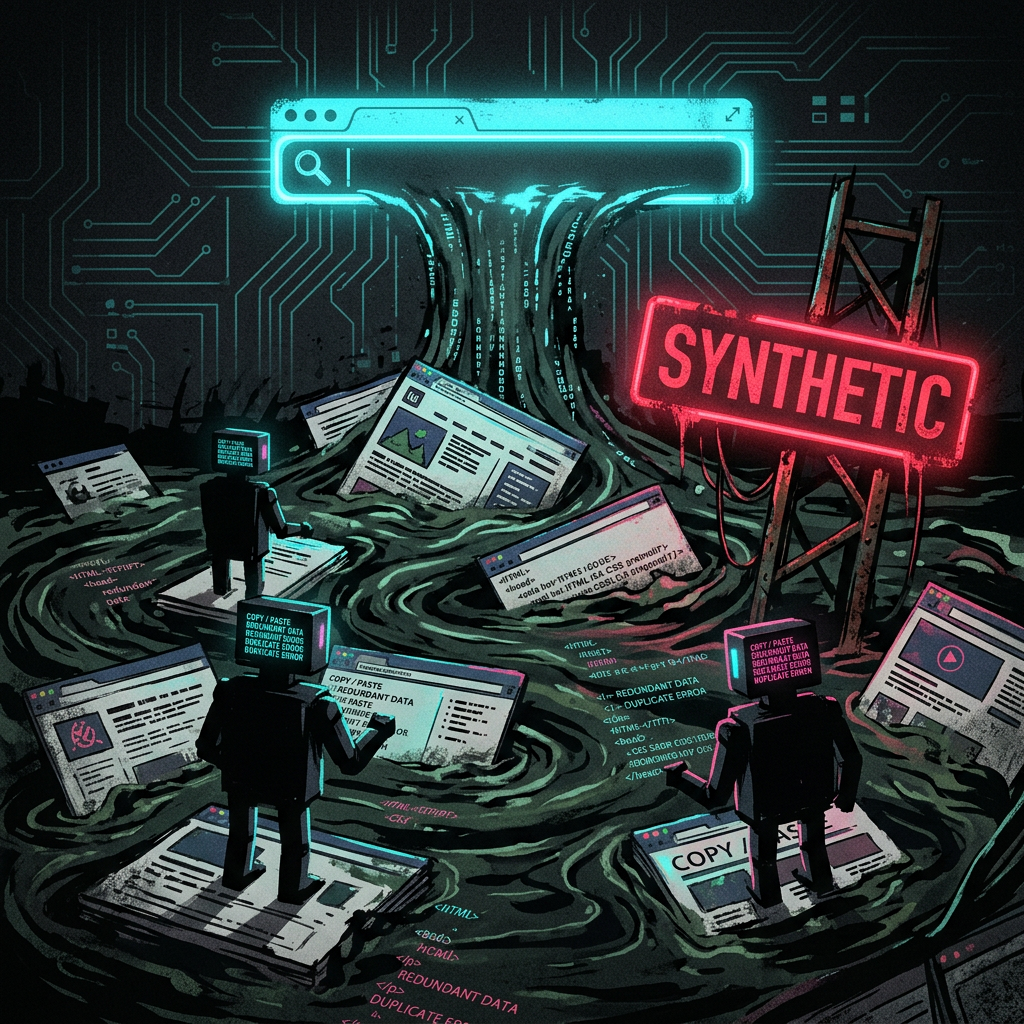
The internet used to be a landfill with occasional treasures. Now it's becoming a landfill that reproduces. We're entering the era where content is trained on content that was trained on content that was trained on... You get it. A photocopy of a photocopy, but with more affiliate links and SEO keywords baked in.
If the web is the world's memory, we're currently letting a spam bot rewrite the diary.
AI models are increasingly trained on synthetic content—text and images generated by other AI systems. This creates a feedback loop where low-quality, AI-generated sludge pollutes the training data, degrades model performance over time (a phenomenon called "model collapse"), and fills the web with spam-optimized pages that rank higher than actual information. Meanwhile, publishers get squeezed: traffic drops, ad rates fall, and the only rational move becomes "pump more content faster." The incentive stack now rewards volume over truth, and bad information is cheaper to produce at scale than good information.
Model Collapse Is Real, and It's Spreading
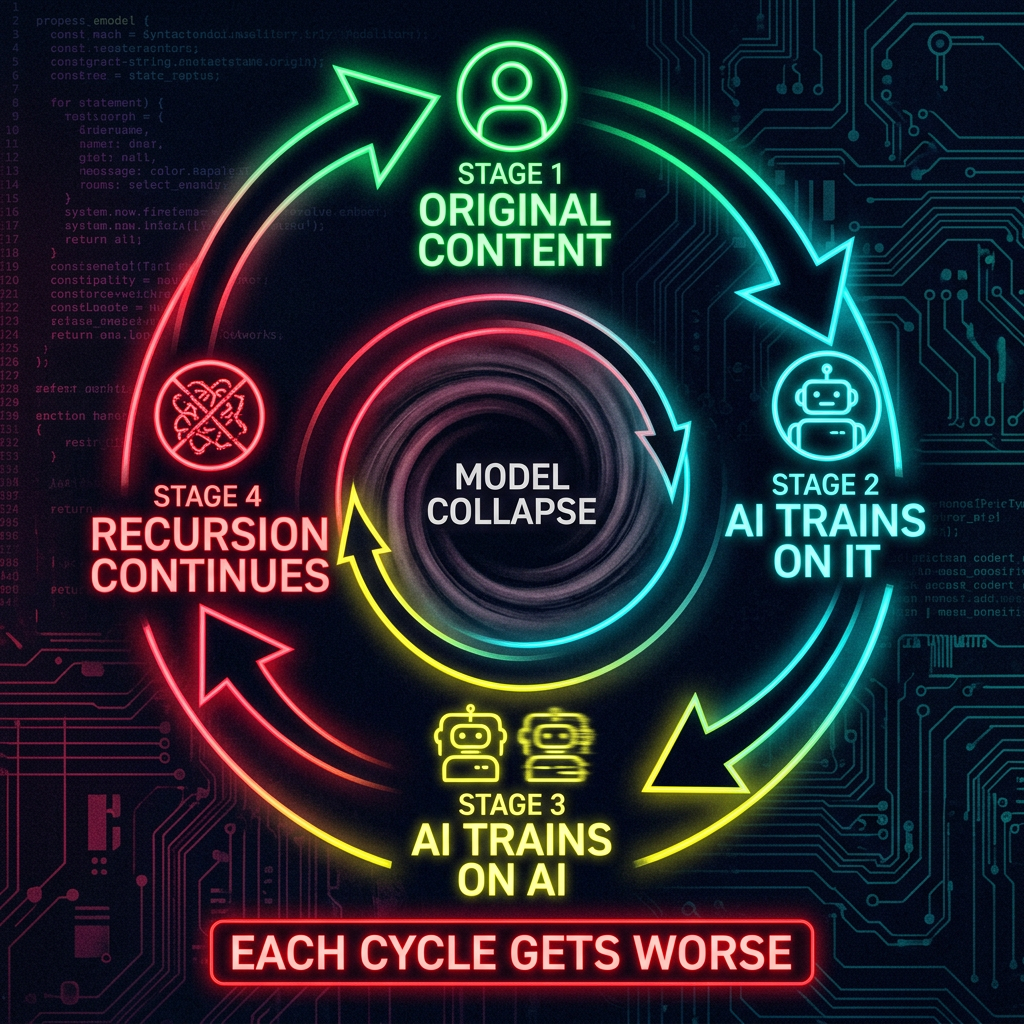
Training AI models on synthetic data creates a compounding problem: each generation of AI-generated content is slightly lower quality than the last. Feed that degraded content back into the next model, and you get worse outputs. Researchers at Stanford and MIT have documented this "model collapse" effect—and we're already seeing it in real-world systems.
The result? AI chatbots start hallucinating more. Image generators produce weirder artifacts. Search results get fuzzier. And the web fills with millions of AI-generated listicles, "how-to" guides, and product reviews that are technically readable but functionally useless.
[Source: Shumailov et al., "The Curse of Recursion," 2024]
Publishers Are Caught Between Starvation and Spam
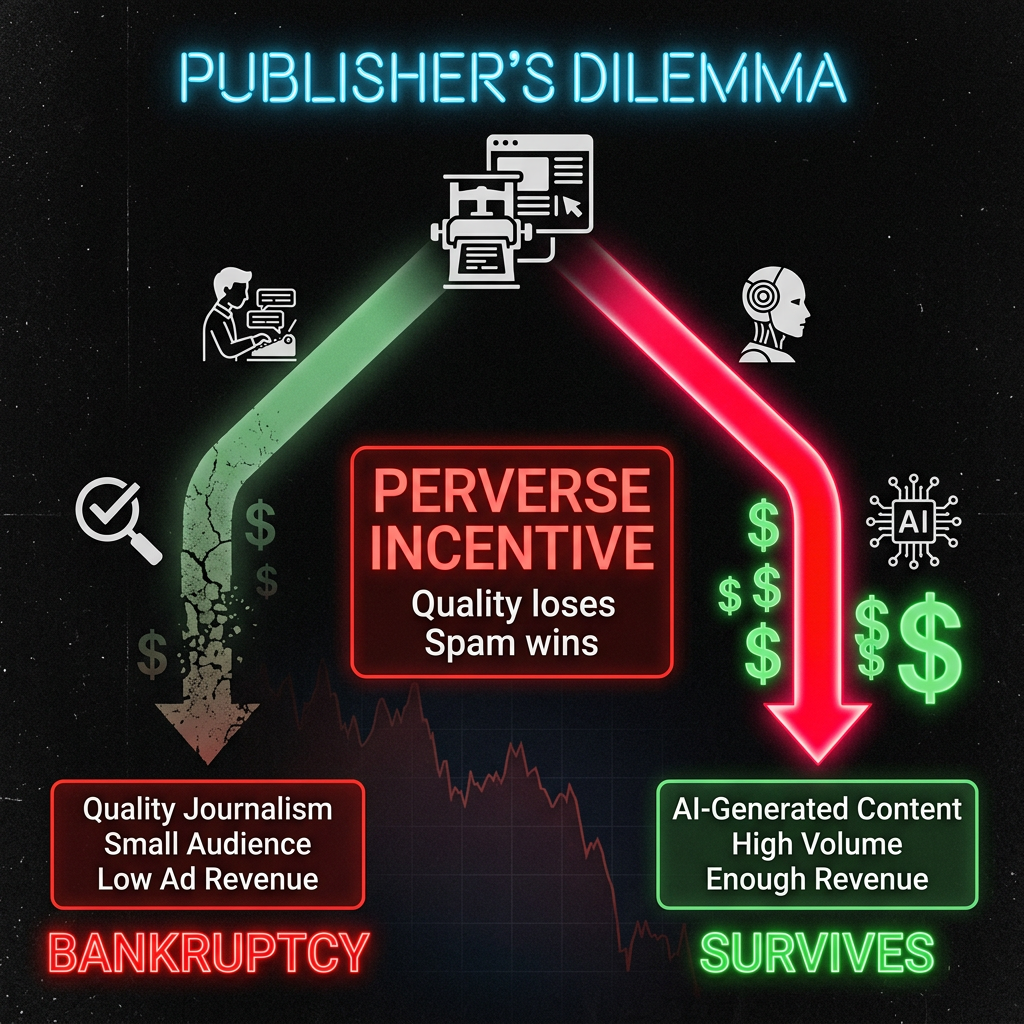
Google's algorithm changes over the past decade have already decimated traffic to quality publications. Now, with AI content generation making bulk content production nearly free, the math for publishers becomes brutal:
- Invest in quality journalism → small audience → low ad revenue → revenue can't cover costs
- Pump out AI-generated content → large volume → some traffic → enough revenue to survive
Many publishers are choosing option 2. Major publishers are now experimenting with AI-generated "news" summaries, product guides, and filler content. Some have been caught publishing AI articles verbatim without disclosure or editing.
The perverse incentive: if everyone else is spamming, and you're the only one making real journalism, you lose.
[Source: Reports from BuzzFeed, CNET, and others on AI content experimentation; media economics analysis]
Detection Is Failing, and Provenance Is a Disaster
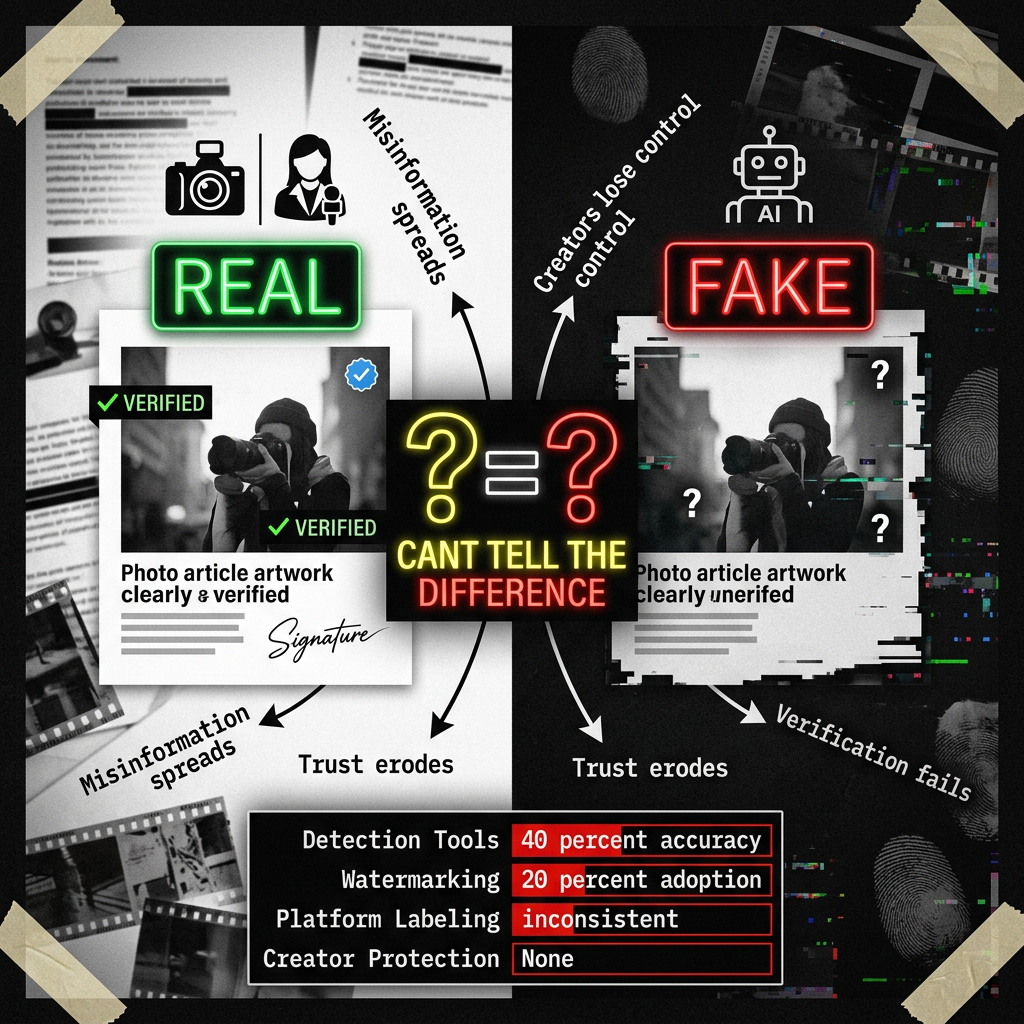
We can't reliably detect AI-generated content at scale. Watermarking standards exist but aren't widely adopted. Most social platforms lack a consistent way to tag or verify whether an image or article is AI-generated.
The result? You can't tell what's real anymore. An AI-generated image of a politician saying something inflammatory spreads as fast as a real image. An AI-written "news story" about a company gets indexed by search engines and cited by actual journalists who didn't know it was fake.
Meanwhile, original creators—photographers, writers, artists—have no way to prove their work is real or to track where it's being used to train new models without their consent.
[Source: MIT Media Lab on detection failure; digital rights organizations on watermarking adoption rates]
Context Links
Related reading on the mechanics:
- Model Collapse Research — Stanford/MIT paper on recursive training degradation
- AI Content Farms Operating at Scale — Platforms struggling to moderate AI spam
- Major Publishers Experimenting with AI Writing — Google News and media partners testing synthetic content
Why It Matters
Search quality degrades. You already notice this: Google results are getting worse. More spam, more AI-generated nonsense, fewer actual sources. As the index fills with synthetic pages, search becomes less useful. This is already happening.
Information gatekeeping shifts. If you can't trust public search or social feeds, the only reliable information will come from paywalled newsletters, subscription services, and closed platforms. This inverts the "democratization of information" narrative. Instead, we get re-gatekeeping through subscription.
Original creators get crushed. Writers, photographers, and artists are losing control of their work. It's being scraped to train models without consent or compensation. Simultaneously, they can't compete with AI-generated content because it's free and optimized for volume.
Real expertise becomes scarce and expensive. If the free web fills with AI sludge, the only way to access actual expert knowledge is through institutions, paywalls, or direct subscriptions. This creates a two-tier information system: garbage for everyone, quality for those who pay.
What to Watch Next
- Provenance verification tools. Expect cryptographic signatures, blockchain-backed content verification, and platform-level labeling to distinguish AI-generated from human-created content. Most won't work perfectly, but some will become standard.
- Publisher strategy shift. More subscriptions, more direct-to-reader newsletters, more paywalls. The "free ad-supported web" is being replaced by "pay-or-get-spam."
- Regulatory intervention. EU regulations on AI content disclosure are coming. The US Congress is paying attention. Expect requirements for watermarking, content labeling, and disclosure of synthetic training data sources.
- Model collapse acceleration. As more models train on synthetic data, degradation will compound. We'll see a visible quality cliff around 2026–2027 if trends continue.
The Practical Takeaway
If you care about information quality, you're entering the era of trusted lanes:
- Curated feeds (Newsletters you subscribe to, run by people with reputational skin in the game)
- Direct subscriptions (Publications that exist independent of ad-based search/social)
- Primary sources (Original research, official statements, archived documents)
- Verification-first platforms (Smaller communities with moderation and provenance checking)
The "free internet" isn't going away, but it's increasingly sludge. The good stuff is moving behind paywalls, community gates, or curation walls.
Sources
- Shumailov, I., Shumaylov, Z., Zhao, Y., Gal, Y., Papernot, N., & Anderson, R. (2024). "The Curse of Recursion: Training on Generated Data Makes Models Forget." arXiv preprint arXiv:2404.01413.
- Platformer reporting on AI content farms and platform moderation failures (2024–2026)
- MIT Media Lab research on AI detection limitations and watermarking adoption
- Major media outlets (BuzzFeed, CNET, etc.) reporting on AI content experimentation
- Google News and search quality discussions (The Verge, Platformer, Nieman Lab)